
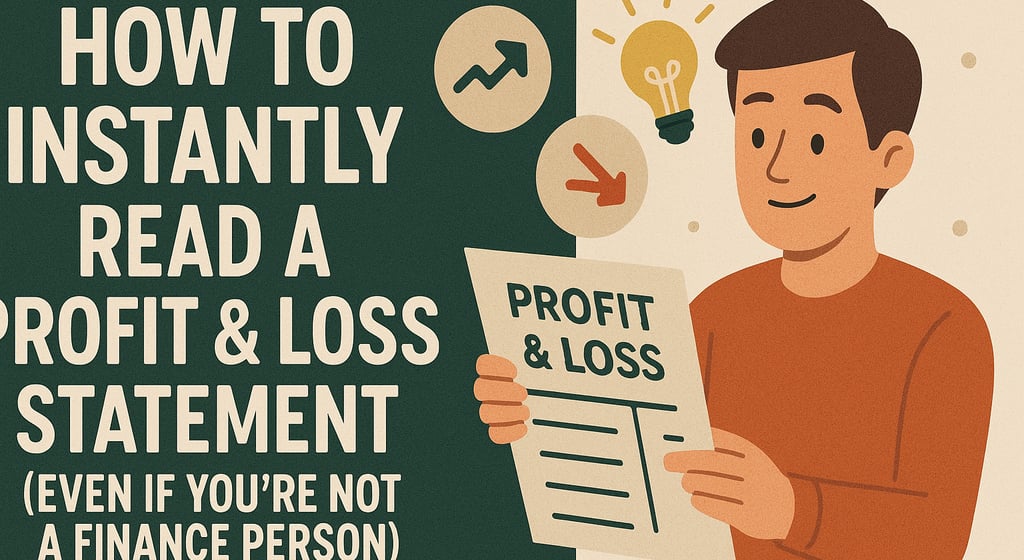
🧾 How to Instantly Read a Profit & Loss Statement (Even if You're Not a Finance Person)
Learn how to read a Profit & Loss statement in plain English — even if you’re not a finance expert. A simple guide to understanding your business’s real financial health.
4/3/20252 min read
If you’ve ever opened a Profit & Loss (P&L) statement and felt like you were staring at a foreign language, you’re not alone.
But here’s the good news: reading a P&L isn’t about being an accountant — it’s about understanding the story of your business.
📊 What Is a Profit & Loss Statement?
A P&L shows your income, your expenses, and what’s left over (your net profit or loss) over a set period — usually monthly, quarterly, or yearly.
Think of it as your business's report card.
🧩 The 3-Part Breakdown (In Plain English)
Revenue (aka Sales or Income)
This is all the money your business brought in from customers.
Tip: Check if this number is going up each month. If not, your top line might be the real issue — not just your spending.
Expenses
These are the costs it took to keep the business running (payroll, software, supplies, etc.).
Look for: Any expense category that’s ballooning without driving more revenue.
Net Profit (or Loss)
Revenue minus Expenses = What’s left over.
Simple Test: If this number’s negative or razor-thin, you’re not just losing money — you’re also not building a buffer for taxes or growth.
🛠️ Quick Ways to Make a P&L More Useful
Sort expenses by category so you can spot what’s eating your profit.
Compare against last month — look for spikes or drops.
Add percentages (e.g., Rent = 12% of income). That shows how lean or bloated each part of your business is.
💡 Why This Matters
A clean P&L lets you:
Know if you’re truly profitable — not just busy.
Catch overspending before it drains your cash.
Make smarter decisions (like when it’s safe to hire or upgrade).
Most people avoid their financials because they’ve only seen the messy version.
Once you learn to read a P&L, everything gets clearer.
🚀 Want Help?
If you’re not sure where to start, I offer a free Business Tune-Up Report that breaks down your numbers in plain English and shows where you might be leaking money or missing out on deductions.
No stress, no spreadsheet skills needed. Just clarity.
Let me know if you'd like a peek at yours.
Services
Professional bookkeeping, tax prep, and mobile notary services.
Contact
Connect
LINKS
📠 (706) 438-8220
Phone
Fax